

The filling, not the delicate wrapper, is what makes two momos feel like different meals. In a vegetarian vs meat momo comparison, the contrast goes beyond what’s inside: one bite may feel lighter and more varied, while another can bring a deeper, more savoury richness. To compare them, notice the filling’s flavour, texture and how substantial it feels.
If you’ve ever wondered which style better suits your appetite, start with what you enjoy in a dumpling filling. Momo is a beloved part of Nepali food culture, with its own character and place at the table; it isn’t simply interchangeable with every other dumpling. The filling shapes its personality, while the occasion can help you decide what to order.
This guide explores how vegetarian and meat momo can differ in taste and texture, and when each might feel like the better fit, from a varied bite to a more savoury one. At Alyonna Bliss, momo is part of a broader Indian and Nepali dining experience, alongside dishes to enjoy over a meal or share with others.
Key Takeaways
- Momo belongs to Nepali and Himalayan food traditions; vegetarian and meat versions share the same dumpling identity.
- In the vegetarian vs meat momo comparison, consider flavour, texture and perceived richness rather than judging by filling alone.
- Seasoning and cooking method shape each bite, so broad assumptions about either style may not match every recipe.
- Use your appetite and preferred mouthfeel to guide your choice, then let the occasion help make the final call.
- Enjoy momo as part of a wider Indian and Nepali dining experience at Alyonna Bliss.
Vegetarian vs Meat Momo: What Makes These Nepali Dumplings Different?
Momo is a filled dumpling associated with Nepali and wider Himalayan food traditions. Vegetarian and meat momo are two expressions of the same dish, distinguished chiefly by what’s folded inside. The filling shapes the flavour and bite, but choosing vegetables or meat doesn’t change the dumpling’s identity.
Momo has a place in Nepalese and Tibetan food cultures, with variations that reflect different cooks and traditions. The overview of Momo (food) offers helpful context on its cultural associations and vegetable and meat variations. Momo is best understood on its own terms, rather than treated as a generic label for every filled dumpling. Its wrapper encloses a seasoned centre, bringing a tender outer layer and a warm, savoury or fresh-tasting filling together in each bite.
There isn’t one fixed recipe for either category. Ingredients, seasoning, proportions and preparation vary between households and kitchens. The most useful distinction is therefore not a rigid ingredient checklist, but the kind of eating experience each filling can offer.
What goes inside vegetarian momo?
Vegetarian fillings are built around vegetables, which can bring freshness, gentle sweetness and varied textures. Depending on the recipe, the mixture may feel crisp, soft or satisfyingly varied; the balance depends on the ingredients and how they’re prepared. There’s no single combination that defines every vegetarian momo. One version may taste bright and fresh, while another is more rounded and deeply seasoned.
What distinguishes meat momo fillings?
Meat can lend a filling savoury depth and a fuller impression, though the result depends on the recipe, seasoning and texture. Nepali momo traditions shouldn’t be reduced to one supposedly universal meat choice. Fillings vary between cooks and menus, and their character can range from delicate to richly savoury.
For a practical comparison, notice three things: how pronounced the savoury flavour feels, whether the filling seems light or substantial, and how its texture meets the wrapper. These impressions aren’t rules about quality. A well-seasoned vegetarian filling can be deeply satisfying, just as a meat filling may be mild rather than intensely rich. In the vegetarian vs meat momo choice, the filling is the starting point, not the whole story.
Rather than expecting every vegetarian version to taste alike or every meat version to have the same weight, approach each as its own recipe. A shared wrapper and culinary tradition bring the two styles together; the filling gives each its particular warmth, texture and flavour.
How Vegetarian and Meat Momo Differ in Flavour and Texture
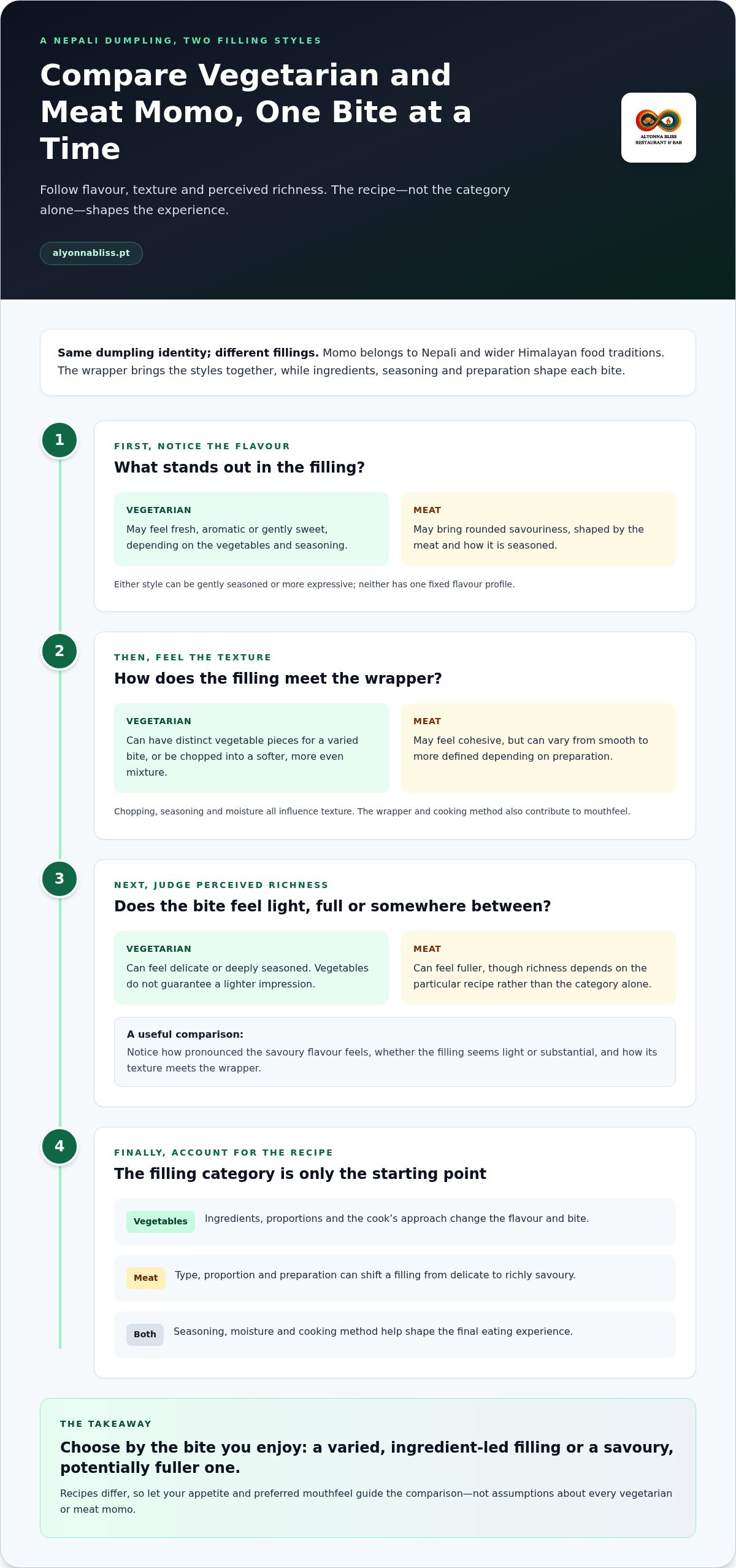
Vegetarian and meat momo are best compared as eating experiences rather than fixed flavour profiles. Vegetables may offer a more varied bite, while meat can bring cohesive, savoury depth. Neither result is automatic: the recipe, seasoning and moisture of the filling all help shape what you taste.
| What to notice | Vegetarian momo | Meat momo |
|---|---|---|
| Flavour | May feel fresh, aromatic or gently sweet, depending on the vegetables and seasoning. | May have a rounded savouriness, shaped by the meat and how it’s seasoned. |
| Texture | Can range from distinct pieces to a soft, closely mixed filling. | May feel cohesive, though the texture varies with how the filling is prepared. |
| Perceived richness | Can be delicate or deeply seasoned; vegetables don’t guarantee a lighter impression. | Can feel fuller, but richness depends on the recipe rather than the category alone. |
| Ingredient variability | Changes with the vegetables, their proportions and the cook’s approach. | Changes with the type of meat, its proportion and the cook’s approach. |
Flavour: fresh and aromatic or savoury and rounded?
A vegetable filling can carry the individual character of its ingredients, creating layers of freshness, sweetness or earthiness. Herbs and aromatics may lift those notes, while spices can add warmth and complexity. Meat can contribute a deeper savoury base, but herbs, spices and aromatics shape that filling too. The vegetarian vs meat momo distinction isn’t simply a choice between mild and spicy, or delicate and bold. Either can be gently seasoned or strongly expressive, depending on the recipe.
Texture and richness: what changes with the filling?
Vegetable pieces may remain distinct, giving a filling a varied bite, or be chopped and combined into a softer, more even mixture. A meat filling may feel more cohesive, but its texture isn’t uniform by definition. Chopping, seasoning and moisture matter: a finely prepared mixture can feel smooth, while a coarser one has more definition. These details also affect perceived richness. The wrapper and cooking method contribute to the overall mouthfeel, but much of the contrast begins with the filling.
Vegetables can bring a varied, ingredient-led bite, while meat can lend a cohesive savouriness. Seasoning and preparation give either style its own character.
Whichever filling is being prepared, clean handling and keeping raw ingredients separate from ready-to-eat food matter for food safety. FoodSafety.gov outlines practical food safety steps for preparation that apply broadly in the kitchen.
Enjoy momo as part of a Nepali and Indian meal at Alyonna Bliss.
Vegetarian vs Meat Momo: Which Filling Suits Your Preferences?
The right momo is the one that suits what you’re in the mood to taste. You might prefer a vegetable-led filling with different notes in each bite, or lean towards the savoury depth and more substantial character meat can bring. These are preference cues, not rules about quality or how satisfying a meal should be.
Use the filling as a starting point, then think about the experience you want: varied or cohesive, fresh-tasting or deeply savoury, delicate or more substantial. The recipe matters as much as the category. Seasoning, preparation and the balance of ingredients can give two fillings in the same broad style very different personalities.
When vegetarian momo may be the more appealing choice
Choose a vegetable-led filling if you enjoy variety and like tasting the different qualities ingredients bring together. Depending on the recipe, the result may feel fresh, gently sweet, earthy or aromatic. Vegetarian doesn’t mean plain: thoughtful seasoning can add warmth and depth. Preparation matters too, whether the individual ingredients stand out or blend into a more unified bite.
Keep dietary needs separate from flavour preferences. “Vegetarian” doesn’t automatically mean vegan or free from allergens, and a label alone doesn’t establish what a particular recipe contains. If a dietary restriction matters, use ingredient and allergen information for the specific preparation rather than relying on the filling category as a guarantee.
When meat momo may better match your appetite
A meat filling may appeal if you’re looking for savoury depth and a more substantial-feeling bite. That’s a matter of personal taste, not an objective measure of satisfaction. Meat momo needn’t be heavy or strongly seasoned; the recipe can be delicate, aromatic or richly savoury. Consider what sounds inviting rather than assuming every meat filling will taste or feel the same.
It also helps to set aside two familiar assumptions: vegetarian momo must be plain, and meat momo must be heavy. Neither holds across every recipe. Vegetables can be seasoned with care and offer plenty of character, while a meat filling can be balanced and tender rather than weighty. Your preference may shift with the moment: a varied bite may suit one meal, while savoury depth sounds right another time.
For a quick decision, ask yourself:
- Do you want ingredient variety? A vegetable-led filling may be a natural place to start.
- Are you craving savoury depth? Meat may better match that particular appetite.
- What mouthfeel sounds appealing? Think about whether you prefer distinct, varied bites or a more cohesive filling.
There’s no need to treat the choice as a verdict on nutrition or quality. Dietary suitability depends on the exact ingredients and your own needs, while taste comes down to what you enjoy. In the vegetarian vs meat momo decision, let curiosity lead: follow the flavour and mouthfeel that appeal, and stay open to discovering a different favourite next time.
How to Choose Between Vegetarian and Meat Momo
A good choice starts with your appetite, not a rule about which filling is better. Think about the flavour you’re drawn to, the ingredients you prefer and how you want each bite to feel. Since recipes vary, those clues are more useful than assuming every vegetarian filling is light or every meat one is rich.
Start with the flavours and ingredients you enjoy
First, decide whether you’re in the mood for vegetable-forward notes or a savoury filling with a meat base. Then consider the recipe: vegetables, seasoning and meat choices can differ from one cook to another, changing the flavour and texture. If you enjoy aromatic seasoning, for example, either category could appeal. Let the combination guide you rather than choosing by label alone.
Match the momo to the way you want to eat
Think about the occasion, too. Momo can be enjoyed as a snack, shared as a plate or chosen as part of a broader meal. When eating with others, different preferences at the table can make the filling a useful point of discovery. Consider whether you want momo as a small savoury pause or as one part of a longer spread. A guide to enjoying traditional Himalayan momo can offer useful cultural context as you explore the dish.
- Check your appetite. Are you craving vegetable-led flavour, savoury depth or simply something new? Begin with what sounds inviting right now.
- Think about ingredients. Consider whether you’d prefer a vegetable-based filling or one made with meat. Recipes differ, so don’t assume the category tells you every ingredient or flavour detail.
- Choose the mouthfeel you want. A filling with distinct pieces may suit you, or you might prefer a more cohesive bite. Preparation affects both, so keep your preference flexible.
- Take the occasion into account. For a shared meal, choose what will bring pleasure to the table; for personal exploration, follow your curiosity.
Rule of thumb: Choose the filling that sounds right for your appetite, and let the recipe surprise you.
If you’re curious, try vegetarian and meat momo on separate occasions. A little space between tastings makes it easier to notice differences in seasoning, texture and overall character, without turning the choice into a contest. You may find one suits a particular mood, while the other becomes your pick at another meal. That’s part of the pleasure of exploring Nepali food: each dish offers a reason to gather, taste and share.
For your next momo meal, explore momo at Alyonna Bliss as part of an Indian and Nepali dining experience.
Enjoy Momo at Alyonna Bliss: From Comparison to the Table
After comparing flavours and textures, the choice comes down to what you enjoy, the ingredients that suit you and the kind of meal you want today. There’s no single winner in the vegetarian vs meat momo debate. A vegetable-led filling may catch your interest one time, while a savoury meat filling may sound more appealing another. The pleasure is in discovering your preference, without turning it into a strict rule.
Make momo part of a relaxed South Asian meal
At Alyonna Bliss, momo is part of an Indian and Nepali dining experience. A meal can be a chance to settle in, share conversation and explore flavours together, whether momo is the dish you’ve come for or one part of a wider meal. If you’re learning about the dish’s cultural roots and traditions, a guide to enjoying traditional Himalayan momo can add context to each new taste.
Sharing food makes comparison feel less like a decision to get right and more like an invitation to explore. Notice what you enjoy: a particular savoury note, a filling’s texture or the way one bite makes you curious for another. Those impressions are often more useful than broad expectations about what vegetarian or meat fillings should taste like. They can also help you choose confidently next time momo is on the table.
Explore momo your way
There’s room for momo in different kinds of days. Enjoy it as part of a dine-in meal, choose takeaway to bring the meal home or opt for delivery. Each setting offers its own kind of ease, but the central pleasure stays close: making time for a dish rooted in Nepali food culture and sharing it in the way that suits you.
Alyonna Bliss serves momo alongside a broader menu of Indian and Nepali food, inviting you to let curiosity guide the meal. You might focus on momo or explore other dishes as part of the same visit. There’s no need to settle on a favourite before you’ve had the chance to taste and reflect. Let your appetite, the company around the table and the moment shape what sounds good.
Whether you’re new to momo or returning to a familiar favourite, the best choice is the one that brings you pleasure. Enjoy the restaurant’s momo and wider menu through dine-in, takeaway or delivery. Explore momo at Alyonna Bliss.
Let Your Next Momo Meal Be an Exploration
The best way to settle the vegetarian vs meat momo question may be to stay curious. Let your appetite guide the choice, and give yourself room to discover how a new filling, seasoning or shared meal changes the experience. A favourite doesn’t have to be fixed; it can shift with the moment and the company around the table.
Alyonna Bliss brings momo into a wider Indian and Nepali dining experience, with dine-in, takeaway and delivery options, as well as private event dining for shared occasions. Whether you’re gathering around a table or enjoying a meal at home, there’s pleasure in exploring South Asian food one bite at a time.
Explore momo at Alyonna Bliss, and follow your curiosity toward a meal that feels right for you.
Frequently Asked Questions
Is vegetarian momo always vegan?
No, vegetarian momo isn’t automatically vegan. A filling may contain dairy ingredients such as paneer, and some recipes may use other animal-derived ingredients. Vegetarian describes the absence of meat, while vegan excludes animal products more broadly. If you’re avoiding dairy or following a vegan diet, check the specific recipe’s ingredients rather than relying on its vegetarian label. Recipes differ, so the name alone doesn’t tell you everything inside.
Does meat momo always contain chicken?
No, chicken isn’t the only possible meat filling. Choices vary between cooks and culinary traditions, so the word “meat” doesn’t identify a single ingredient. When choosing from a menu or recipe, read the filling description carefully, especially if you have a preference or dietary restriction. Don’t assume a specific meat from the general label or treat one recipe as the standard for every momo.
Which is more filling, vegetarian or meat momo?
Neither category is automatically more filling for everyone. How substantial a serving feels depends on portion size, the ingredients and your own appetite. A densely packed vegetable filling may feel satisfying to one diner, while another may prefer the texture of a meat-based filling. Consider what else you’re eating, too: a few momos as a snack may feel different from having them as part of a larger meal.
Are vegetarian momo less flavourful than meat momo?
No, a vegetarian filling isn’t inherently less flavourful. Its character depends on the ingredients, seasoning and preparation; vegetables can offer aromatic, layered notes, while meat can bring savoury depth. Either filling may be subtle or richly seasoned. Make the vegetarian vs meat momo choice by considering the flavours you enjoy, not by assuming one style is bland and the other automatically more expressive.
Can momo fillings vary from one recipe to another?
Yes, fillings and seasoning can change from cook to cook, so neither category has one fixed recipe. For example, Nepali Taste features a vegetable momo recipe with cabbage, carrot, paneer and timur. That’s an illustration, not a universal ingredient list. If a particular ingredient matters to you, use the details for the specific recipe you’re considering.
What is the difference between momo and dumplings?
Momo is a particular dumpling tradition associated with Nepali and Himalayan foodways; “dumpling” is a broad term used for filled or shaped dough preparations across many cuisines. The words aren’t interchangeable in every context: dumplings can differ widely in wrapper, filling and cooking method. Calling momo a dumpling describes its form, while its name and cultural associations point to a distinct food tradition.


