

What makes a momo fold hold its filling without turning the wrapper into a tight, uneven knot? The answer isn’t simply more pleats. Whether you’re practising at home or searching for fresh momo delivery, a successful fold balances a secure seal with an even layer of dough that can cook through without tearing.
Those small hand movements are easier to learn when you break them into a repeatable sequence. This guide explains how the wrapper, filling, and seam work together, compares common momo shapes, and offers practical ways to troubleshoot gaps, tears, and dry edges.
Folding is a tactile part of momo-making, shaped by patience and practice. When you’d rather enjoy the finished dish, Alyonna Bliss serves freshly steamed or fried momos and offers food delivery. For now, begin with a simple goal: make a fold that closes securely, keeps the wrapper even, and leaves room for the filling.
Key Takeaways
- A good momo fold keeps the wrapper even and seals the filling inside.
- Use a consistent amount of filling, keep the wrapper border clean, and press the seam closed as you shape it.
- Crescent and gathered shapes use different hand movements, but either can make a secure dumpling.
- Practise slowly with a few test dumplings, changing one part of your technique at a time.
- After exploring the craft, enjoy freshly steamed or fried momos from Alyonna Bliss, with momo delivery lisbon as a convenient way to savour them.
Himalayan Dumpling Folding Technique: What Makes a Momo Fold Work?
A momo fold shapes a soft wrapper around its filling and seals it so the dumpling stays together during cooking. The wrapper needs to bend without splitting, and its edges need to meet closely enough to contain the filling. A decorative shape is a bonus; the fold’s first job is to create a reliable seam and an even layer of dough.
A momo fold is a seal first and a decoration second: it holds the filling securely while keeping the wrapper even enough to cook through. If one area is stretched thin while another is bunched into a thick knot, the dough may cook unevenly. Aim to distribute the wrapper around the filling without leaving fragile patches, gaps, or bulky excess at the top.
The wrapper, filling, and seam each have a role
Place the filling in the centre and leave a clear border around it. Bring the edges together with a pinch or a series of small pleats. Keep filling off the border so the dough can make direct contact with itself. A gap in the seam can let juices escape during cooking; pulling too hard can tear the wrapper. Pleats add shape, but a continuous seal is what keeps the dumpling intact.
Why momo shapes and folds can differ
A crescent fold joins the wrapper along a curved edge, while a round pouch gathers the edges toward the top. These are useful examples, not rules for every kitchen. Household methods and regional traditions vary, and no single shape represents every Nepali or Himalayan community. The Momo (food) overview offers further context on the dumpling’s varied forms and cultural significance.
Choose the hand movement that feels manageable, then focus on consistency: use a similar amount of filling each time, keep the wrapper supple, and press the seam closed all the way around. A pouch asks you to gather several sections toward the centre; a crescent has you work along a curved line. In either case, the goal is a closed edge, not identical pleats.
Once you understand why the seam matters, the folds become easier to notice, whether you’re practising at home or enjoying momo delivery lisbon. A secure closure, an even wrapper, and patient handling are the foundations of a momo that holds together as it cooks.
How to Fold a Momo: A Beginner-Friendly Sequence
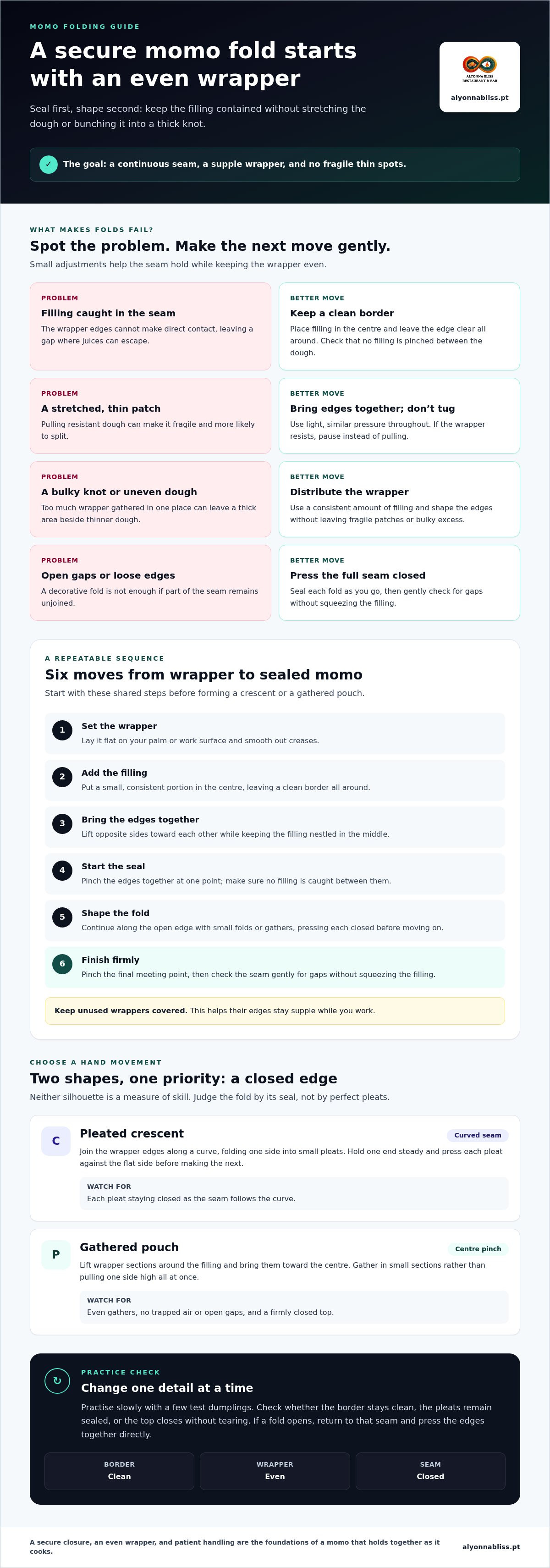
Start with a pliable wrapper and a modest, consistent amount of filling. Keep your fingertips light: bring the edges together rather than stretching the dough. Follow the basic sequence first, then use the same opening steps for either a crescent or a gathered pouch.
- Set the wrapper: Lay one wrapper flat on your palm or work surface, smoothing out creases.
- Add the filling: Put a small, consistent portion in the centre, leaving a clean border all around. Keep the filling away from the edge.
- Bring the edges together: Lift opposite sides toward each other, keeping the filling nestled in the middle.
- Start the seal: Pinch the edges together at one point. Check that no filling is caught between them.
- Shape the fold: Continue along the open edge, making small folds or gathers and pressing each one closed before moving on.
- Finish firmly: Pinch the final meeting point, then check the seam gently for gaps without squeezing the filling.
Use similar, gentle pressure throughout. If the wrapper resists folding, pause instead of pulling; a stretched, thin patch is more likely to split. Keep the wrappers you aren’t using covered so their edges stay supple.
Forming a simple pleated crescent
Centre the filling and keep the border clear. Bring the wrapper edges together and pinch one end securely. Hold that end steady, then use your thumb and forefinger to fold a small section of the open edge toward the opposite end. Press each pleat against the flat side of the wrapper before making the next one. Work along the curve until the seam is closed, checking that each fold meets the previous one.
Shaping a gathered pouch
Lift the wrapper edge around the filling in small sections, moving around the circle instead of pulling one side high all at once. Bring each section toward the centre and pinch lightly as you gather. Keep the folds close to the filling to avoid trapping excess air. When the edges meet, press the top firmly closed. The dumpling should be rounded beneath a gathered crown, with no open gaps or loose wrapper flaring outward.
When practising, check one detail at a time: whether the border stays clean, whether the pleats remain sealed, or whether the top closes without tearing. If a fold opens, return to the seam and press the edges together directly. Repeating the same movement slowly makes it easier to see where your technique needs adjustment.
Once the folds begin to make sense, enjoy the finished dumplings too. Alyonna Bliss serves freshly steamed or fried momos.
Pleated, Crescent, or Pouch-Shaped: Comparing Momo Folds
A momo’s outline can hint at how it was folded, but it isn’t a test of skill or a measure of cultural authenticity. A crescent usually has a curved seam, while a pouch gathers the wrapper toward a central pinch. Either can hold its filling when the edges are joined securely. Choose the hand movement you want to practise and judge the result by its seal, not by whether it matches a perfect silhouette.
| Shape | Basic method | Beginner challenge |
|---|---|---|
| Pleated crescent | Join the wrapper edges along a curve, folding one side into small pleats. | Keeping each pleat closed while guiding the seam evenly. |
| Gathered pouch | Lift sections of the wrapper edge and bring them together at the centre. | Gathering evenly without trapping air or leaving gaps. |
What changes between a pleated and gathered fold?
Pleats make a visible ridge along the sealed edge. Work progressively across the curve, pressing each small fold against the wrapper beneath it. A gathered fold uses a different movement: lift, draw inward, and bring each section toward one central pinch point. Some beginners find a simple crescent easier because the seam advances in one direction; others find gathering more comfortable. Start with the movement that feels steadier in your hands.
Neither shape is the only correct way to make a momo. Folding customs differ between households and communities, so there’s no need to rank a pouch or crescent as more authentic. For a learner, a closed seam matters more than uniform pleats or a perfectly rounded crown. Variation is a normal part of practice.
Common folding problems and their likely causes
A tear can start when the wrapper is overfilled, stretched sharply, or handled roughly. If the edges won’t stick, check for flour dust or filling on the sealing border; either can get between the layers and weaken their contact. Uneven pleats may leave a small gap. Treat that as useful feedback: close the opening gently, then use a lighter touch or smaller folds on the next one.
- If the wrapper splits, use less filling or bring the edges together without pulling the dough taut.
- If the seam slips open, clear the border and press the wrapper layers directly together.
- If pleats vary in size, slow down and make smaller folds, checking that each one meets the previous fold.
When checking a finished momo, inspect the whole seam rather than focusing only on the crown or ridge. An irregular outline can still be securely closed. Shape catches the eye, but a continuous seal is what holds the dumpling together, whether you’re learning at home or enjoying momo delivery lisbon.
How to Practise Momo Folding and Check Your Technique
Confidence comes from repeating one movement at a time, not racing through a batch. Practise the pinch and fold slowly before trying to work at full pace. Make a few test dumplings, then change just one variable, such as the amount of filling or the pressure of your fingers. This makes it easier to see what helps the wrapper stay neat and the seam stay closed.
Set up a calm, workable folding station
Put the filling and a clean work surface within easy reach. Keep unused wrappers covered between folds so their edges don’t dry out and become harder to seal. A light dusting of flour can help prevent sticking, but brush excess away from the border: flour on the seam may stop the edges joining cleanly. Keep the station uncluttered so you can handle each wrapper without rushing.
Read the fold before cooking
Pause with each finished momo and look along its seam. The wrapper edges should meet without filling caught between them. Check for thin, stretched spots, loose pinches, and openings, especially at the top. Similar sizing and filling help the dumplings cook more evenly. Practice pieces don’t need identical pleats, but they should be similarly filled and securely closed.
Use a small test batch to learn from your folds. Place the dumplings beside one another and notice where they differ. If one has a loose top, focus on the final pinch in your next attempt. If the wrapper looks taut or unusually thin, ease your grip or use a little less filling. Changing one detail at a time helps connect a hand movement with the result.
- For a dry edge: Keep wrappers covered and work with one at a time.
- For a weak seal: Clear flour or filling from the border before pressing the edges together.
- For uneven shapes: Slow down and aim for a similar amount of wrapper in each fold.
A well-sealed momo has clean edges joined all the way around, an intact wrapper without thin spots, and a firmly pinched top with no visible opening. Use that check before cooking, then adjust one part of your technique instead of trying to perfect every pleat at once. Noticing these details can also make each dumpling more satisfying to enjoy.
When you’d rather enjoy the finished dish than practise another fold, savour freshly steamed or fried momos from Alyonna Bliss.
From Learning the Momo Fold to Enjoying Momos at Alyonna Bliss
Learning to fold a momo brings attention to the small gestures behind the dish: placing the filling, joining the wrapper edges, and closing the shape with a final pinch. Practice can make those movements familiar, but you don’t need to master every pleat to appreciate the result. Momos are also a pleasure to share around a table, where warm dumplings invite people to pause and enjoy the meal together.
Choose the momo experience that suits the moment
Alyonna Bliss serves freshly steamed or fried momos. Steamed momos offer a softer wrapper, while fried momos have a more textured bite. Choose according to the texture you feel like enjoying; neither option needs to be treated as the better one.
Folding gives a dumpling its shape, while cooking changes the experience of the wrapper. The same curiosity that helps you notice a gathered top or curved seam can make a meal more engaging. Take in the shape and texture, then enjoy each bite at an unhurried pace.
Continue exploring Nepali food with Alyonna Bliss
Alyonna Bliss serves Nepali and Indian food, giving you a chance to explore beyond the dumpling itself. Make momos part of a meal to share, or let them take centre stage. Food delivery is another way to enjoy the restaurant’s menu at home.
For anyone searching for momo delivery lisbon, the fold is only one part of the experience. Understanding how the wrapper comes together can deepen your appreciation, whether you’re practising the movement yourself or choosing momos to enjoy. The most elaborate shape isn’t necessarily the best one; the important thing is a good meal enjoyed in a way that suits you.
Ready to enjoy the finished dish? Explore Alyonna Bliss and its food offering, including freshly steamed or fried momos.
Let the Next Momo Be the Start of Something Shared
There’s pleasure in recognising the care behind a dish, then letting that appreciation lead to a meal worth lingering over. Whether you’re practising your folds or simply curious to taste momos, good food invites us to slow down, share, and enjoy the moment together.
If momo delivery lisbon is your next step, explore Nepali and Indian food with Alyonna Bliss. Gather people you enjoy and let the meal matter more than mastering every pleat. A dumpling doesn’t need to be perfect to bring warmth to the table.
Explore Alyonna Bliss and enjoy our momo offering.
Frequently Asked Questions
How many pleats should a momo have?
There’s no single required number of pleats. The count can change with the wrapper’s size, the shape you’re making, and the folding method you’re comfortable with. Rather than aiming for a particular total, check that the edge stays joined from end to end. Pleats shape the dumpling, but they aren’t a fixed cultural rule; a simpler fold works just as well if it closes securely.
Can beginners fold momos without a mould?
Yes. A mould isn’t necessary: clean fingers and a stable surface are enough to bring the wrapper edges together. Start with a basic pinch, or add small pleats once you feel steady. A mould can help create a repeatable outline, but it doesn’t replace the hand movement that closes the dough. Try a few slow folds first and find a comfortable grip.
Why does momo dough stick to my hands?
Stickiness can come from moisture, handling, or the dough’s consistency. Lightly flour your hands and work surface, adding only a little at a time so the dough doesn’t become dry or tough. Keep unused dough covered while you work. If it still feels difficult to handle, adjust gradually according to a tested recipe rather than adding a large amount of flour all at once.
Can I prepare momo wrappers ahead of time?
You can prepare wrappers before filling them, but exposed dough may dry, while stacked wrappers can cling together. Keep them covered as you work and separate layers so they’re easy to lift without stretching. For longer storage, use a tested recipe or reliable food-safety guidance that explains suitable storage conditions and timing. Don’t rely on appearance alone to decide whether stored dough is still safe to use.
What flour is commonly used for momo wrappers?
Many home recipes use wheat flour for momo wrappers, though ingredients and methods vary. There isn’t one formula that suits every kitchen: flour type, room humidity, and the texture you want can all affect how the dough feels. Follow a tested recipe for proportions, then adjust gradually if the dough seems too sticky or firm. Small changes are easier to manage than substantially changing the mixture.
How can I stop filling from escaping while folding momos?
Leave a clear margin around the filling and avoid adding so much that the wrapper edges struggle to meet. Keep the border free of filling, then press the seam closed in small sections rather than pinching only at the ends. Before cooking, turn the momo gently and inspect the join for openings. A continuous seal matters more than making every pleat look identical.
Can I fold momos in different shapes from the traditional examples?
Yes. Momo shapes vary between cooks and traditions, and a different silhouette can still make a well-sealed dumpling. There isn’t one outline that should be treated as the only authentic form. If you’re trying a shape from a particular community or recipe, learn from sources connected to that tradition and follow their guidance respectfully. For practice, choose a fold your hands can repeat comfortably.


