

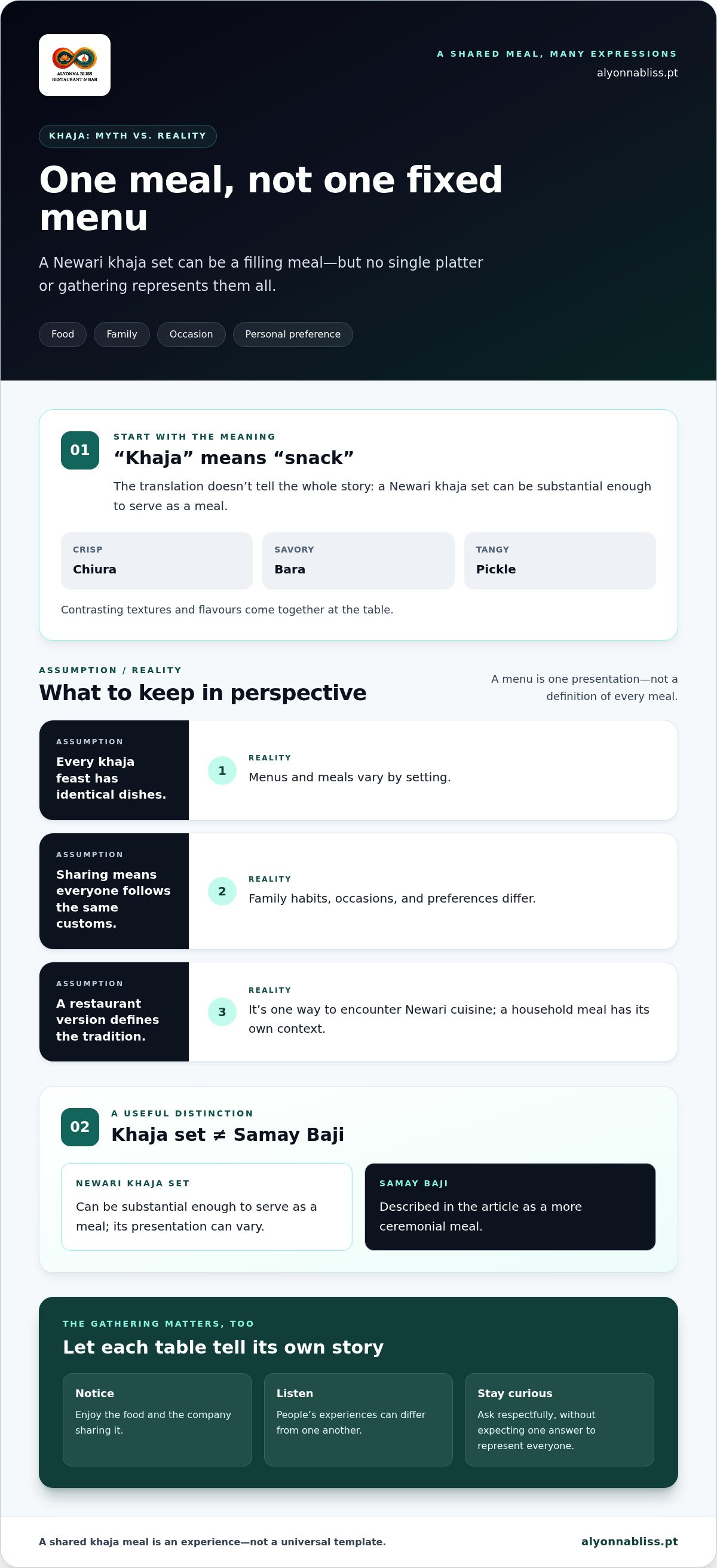
What if the heart of a khaja feast isn’t a fixed list of dishes, but the pleasure of gathering around them? That’s a helpful way to understand the nepali shared khaja feast tradition. “Khaja” translates to “snack,” yet a Newari khaja set can be substantial enough to serve as a meal. Crisp chiura, savory bara, tangy pickle, and other accompaniments bring contrasting textures and flavours to the table.
What makes this more than a plate of food? A shared meal gives people time to sit together, taste at their own pace, and talk. In this article, you’ll learn what khaja means in context, how a khaja set differs from the more ceremonial Samay Baji, and which assumptions deserve a little nuance. Alyonna Bliss serves a Newari khaja set, offering a welcoming introduction to this style of dining.
Key Takeaways
- Understand the nepali shared khaja feast tradition as a way of gathering, not simply a checklist of dishes.
- Learn why a Newari khaja set can vary, and avoid assuming one meal represents every household or occasion.
- Approach another food tradition with curiosity: listen to your host and ask respectful, open questions.
- Enjoy a Newari khaja set at Alyonna Bliss as part of a dine-in meal or shared gathering.
Nepali Shared Khaja Feast Tradition: Why the Gathering Matters
Khaja is commonly translated as “snack,” while a Newari khaja set can be substantial enough to serve as a meal. The word doesn’t describe one fixed occasion or menu; its meaning depends on how it’s used. When you see khaja on a menu, consider whether the set is presented as a light snack or a more filling meal, rather than relying on the translation alone.
What does khaja mean in a shared-meal context?
Khaja means “snack,” though a Newari khaja set may be a full meal, enjoyed in ways that vary by person and occasion. The Newar cuisine overview offers broader context, but no single description can represent every household’s practices.
Why does gathering shape the experience?
Food gives people a reason to pause, talk, and spend time together. That social warmth is a feature of shared meals, not a claim that every Newari gathering follows the same customs. The nepali shared khaja feast tradition is best approached with attention to both the food and the people sharing it.
How Newari Khaja Connects Food, Identity, and Hospitality
Newari khaja belongs to a living food culture, shaped by the people who prepare and share it. The Newar cuisine overview places it within a wider culinary tradition, but no single account captures every family’s experience. Food can connect people with cultural identity while remaining part of everyday life, rather than a custom preserved unchanged.
What makes a Newari khaja gathering culturally meaningful?
A meal’s meaning may come from personal memories, family connections, or the pleasure of welcoming others. These experiences differ, so it’s best not to assume everyone attaches the same significance to khaja. Shared food can express welcome through an open table and generous company, without implying one universal practice.
How can tradition remain flexible?
Family habits, personal preferences, and the occasion all shape how people enjoy a meal. A contemporary gathering can offer a meaningful way to encounter a food tradition without being measured against an imagined single standard. Each table has its own character, and one experience can be appreciated without standing for all.
Khaja Feast Myths vs. Reality: One Fixed Menu or a Shared Tradition?
A restaurant menu can offer a useful introduction, but it can’t define every khaja meal. Keep the distinction between one presentation and a whole food tradition in mind when deciding what to order or how to understand the meal.
Is there one required khaja menu?
No single platter represents every setting. The Newar cuisine overview describes khaja sets alongside Samay Baji, a more ceremonial meal. A restaurant set is one menu offering; a household meal reflects its own context.
Does sharing mean everyone follows the same customs?
No. Family habits, occasions, and preferences differ, so one experience shouldn’t be treated as a universal rule.
- Assumption: Every khaja feast has identical dishes. Reality: Menus and meals vary by setting.
- Assumption: Sharing means identical customs. Reality: People can share food in different ways.
- Assumption: A restaurant version defines the tradition. Reality: It’s one way to encounter Newari cuisine.
The nepali shared khaja feast tradition can be appreciated without expecting one definitive template. Treat each meal as its own experience, and distinguish what a particular menu offers from the many ways people enjoy khaja.
How to Appreciate a Shared Khaja Feast with Curiosity and Respect
A first encounter with a khaja meal is an invitation to enjoy the food and learn from the people sharing it. You don’t need to arrive with a list of rules or expect a host to explain an entire culture. Notice how the meal unfolds, listen to what others say about it, and let the people at the table shape your understanding.
What should a first-time guest keep in mind?
Focus on the company as much as the food. Follow the host’s lead if you’re unsure how the meal is being shared, and ask questions with genuine interest rather than treating the occasion like a performance. Don’t assume a particular gesture, order, or custom applies everywhere.
Open questions make room for personal experience. You might ask, “Is this a meal you grew up enjoying?” or “What do you especially like about sharing it?” If the conversation turns to a family’s own practices, listen without expecting that one answer to stand for everyone. Respectful curiosity means receiving the story offered, not pressing for a definitive account.
How can readers learn beyond a single meal?
Think of one meal as a beginning, not a complete lesson. To keep learning, seek out writing and perspectives from Nepali and Newar voices, alongside credible cultural sources. Pay attention to who is speaking and the context they describe. A personal account can illuminate one person’s experience without claiming to define a whole community.
Look beyond a checklist of foods, too. Consider how people describe the meal, what sharing means to them, and how the occasion fits into their lives. A conversation with family or friends may carry memories across generations; a meal among friends may create new ones. These are possibilities for shared food, not rules every khaja gathering must follow.
For a welcoming guest, a few habits are enough:
- Stay present and let the host guide the pace of the gathering.
- Ask open questions, and accept that someone may not wish to explain every detail.
- Keep what you learn in its proper context instead of applying it to every household or occasion.
- Enjoy the meal without expecting it to confirm a single idea of tradition.
This thoughtful approach suits the nepali shared khaja feast tradition because it honours both cultural meaning and individual experience. To enjoy a Newari khaja set in a welcoming dining setting, plan a shared meal at Alyonna Bliss.
Experience the Spirit of Shared Khaja at Alyonna Bliss
Cultural learning offers a thoughtful beginning; sharing a meal lets the conversation continue around a table. At Alyonna Bliss, the Newari khaja set is one way to encounter this cuisine in a restaurant setting. It offers a point of connection, not a claim to represent every family’s cooking or every occasion. The broader nepali shared khaja feast tradition is varied, and each meal is best appreciated in its own context.
A Newari khaja set as an invitation to share
A meal can bring people together without needing to make a grand statement. The pleasure may be in settling in, tasting at an unhurried pace, and sharing conversation. A Newari khaja set gives diners an opportunity to enjoy a Newari food tradition, while leaving room to experience it personally rather than treating one restaurant presentation as the definitive version.
That distinction matters. Food traditions live through the people who prepare and enjoy them, and no single meal can stand for every household. The set is a welcoming introduction, a way to approach the cuisine with curiosity and enjoy a shared dining moment. Whether you’re familiar with Newari food or meeting it for the first time, let the meal be a chance to discover, taste, and connect.
Gather around food for a meal or occasion
Dine-in meals make space for the small comforts of eating together: conversation between tastes, stories that linger, and the pleasure of staying at the table. For a more personal gathering, Alyonna Bliss also hosts private events, bringing food and company together for occasions shared with family, friends, or guests. The meaning comes from the people around the table, not from any one prescribed way to celebrate.
Sharing a meal can be simple or occasion-marking, familiar or new. Either way, an open table invites people to spend time together and enjoy food in good company. Alyonna Bliss serves Indian and Nepali food, offering a place to explore these cuisines through a relaxed meal or gathering. Take your time, bring your curiosity, and make room for conversation alongside the food.
Explore Nepali and Indian dining at Alyonna Bliss.
Carry the Spirit of Gathering to Your Next Meal
The nepali shared khaja feast tradition invites you to approach food with curiosity and make time for the people around the table. Let that spirit travel beyond one meal. Invite a friend to try something unfamiliar, share a favourite dish with family, or linger over good conversation. Small gestures can turn eating together into a moment of welcome.
There’s no need to master every cultural detail before enjoying a new cuisine. Bring an open mind, respect the stories that accompany the food, and let each experience teach you something without standing for every experience. Appreciation grows one shared table, one conversation, and one new taste at a time.
For a relaxed opportunity to enjoy Nepali and Indian food, explore dining at Alyonna Bliss. Bring someone you enjoy spending time with, settle in, and let the meal create room for conversation and discovery.
Frequently Asked Questions
What is a Nepali khaja feast?
Khaja is commonly translated as “snack,” though a Newari khaja set can be substantial enough to serve as a meal. The Newar cuisine overview helps place it within a wider culinary tradition. A feast isn’t defined by one required menu: the nepali shared khaja feast tradition is better understood through the food and the people and occasion bringing them together.
Is khaja always eaten communally?
No. Khaja can be enjoyed in a social setting, but the word alone doesn’t mean every serving is communal. Someone might encounter it as a restaurant set or as part of a meal with others; households and occasions differ. If you’re invited to share, take your cues from the people present instead of assuming a specific custom. One table offers a real experience, not a universal rule.
What is the difference between khaja and a regular meal?
Khaja doesn’t always name a separate meal category with a fixed time or format. It’s often translated as “snack,” yet a Newari khaja set may be substantial enough to function as a meal. The distinction is contextual: the word may suggest a snack, while the set can be more filling. The Newar cuisine overview provides cultural context, but it shouldn’t be treated as a definition for every use.
Can a khaja feast be part of a modern gathering?
Yes. People can enjoy khaja in a present-day restaurant meal, a get-together with friends, or a family occasion. The setting may change while the pleasure of sharing food remains. There’s no need to compare a modern gathering with an imagined standard of tradition; each occasion has its own company and character. Let the people sharing the meal explain what it means to them.
What should a first-time guest know about sharing khaja?
Arrive curious, pay attention to your host, and enjoy the meal without expecting a lesson or performance. If something interests you, try an open question such as, “Is this a food you enjoy at family gatherings?” A host may share a personal memory or talk about what they like. Receive that answer on its own terms, rather than treating it as a rule for everyone.
Does every Newari khaja set contain the same foods?
No single set should be assumed to represent every table. Restaurant menus present a particular version, while household meals can reflect the host’s preferences, the occasion, and family habits. Even a familiar name doesn’t guarantee identical contents everywhere. Treat a restaurant’s khaja set as that restaurant’s offering and an opportunity to experience one expression of Newari cuisine.
Where can I experience a Newari khaja set?
Alyonna Bliss serves a Newari khaja set as part of its Nepali and Indian dining. It’s one restaurant’s presentation, not a stand-in for every household or tradition. Enjoy it as a dine-in meal, letting the food and conversation unfold at the table. Alyonna Bliss also hosts private gatherings and social events. Explore Nepali and Indian dining at Alyonna Bliss.


