

What if the best way to enjoy a Thakali thali isn’t to master a set of rules, but to find your own rhythm among its many flavours? With dal, rice, chutney, a variety of curries, butter, and more gathered on one platter, it’s understandable to wonder where to begin or whether everything belongs in the same bite. Learning how to eat thakali thali can make that first taste feel less like a puzzle and more like an invitation.
Start with a little rice and dal, then add a small taste of curry or chutney and notice how it changes the bite. You can try each element on its own first, too. There’s no need to rush or make every mouthful identical. This guide explains how to recognise the platter’s main components, build balanced bites, and enjoy the meal comfortably, while keeping your own spice preferences in mind.
At Alyonna Bliss, the Nepali Thakali thali brings these familiar elements together in one meal. Read on, take your time, and let each taste lead naturally to the next.
Key Takeaways
- Understand how Thakali cuisine reflects the Thakali community and its culinary tradition.
- Use a simple first-bite approach to learn how to eat thakali thali without feeling overwhelmed by the platter.
- Choose flavour combinations that suit you; there’s no prescribed order for balancing milder and more vivid tastes.
- Enjoy the meal with your hands or cutlery, whichever feels comfortable, without treating dining customs as a test.
- See how Alyonna Bliss brings dal, rice, chutney, curries, butter, and more together on its Nepali Thakali platter.
What Is Thakali Thali? Get to Know the Meal Before Your First Bite
A Thakali thali is a complete Nepali meal served as several complementary components, rather than one curry on its own. Rice and dal provide a grounding centre, while curries, chutney, and other sides add different textures and flavours. The selection and arrangement can vary, so think of the platter as a balanced meal, not a fixed checklist.
A Thakali thali is a composed meal of rice, dal, and accompanying dishes, served together so each element can be enjoyed alone or brought into a shared bite. The sides aren’t simply extra portions of one main dish. They give you different ways to season, brighten, and vary the central pairing.
Where the Thakali meal gets its name
“Thakali” refers to the Thakali people and their culinary tradition. Learning about the Thakali people offers a useful starting point for understanding the community behind the meal. For a first-time diner, the key idea is simple: this is a named food tradition, not just another word for any Nepali platter.
How to read the different parts of the platter
Look for rice as the substantial centre and dal, a lentil preparation, as a savoury companion. Curries and chutney sit alongside them, bringing variety: one bite might feel mellow and comforting, another more vivid or tangy. The components can complement one another, but you don’t have to combine everything at once. Take time to notice each dish.
Additional sides depend on the restaurant and the particular set. The number, type, and arrangement can change, so don’t worry if your platter looks different from a photograph or another restaurant’s version. Read it as a collection of choices around a familiar centre, rather than a test with missing answers.
At Alyonna Bliss, the Nepali Thakali platter includes dal, rice, chutney, a variety of curries, butter, and more. These familiar elements show the meal’s composed structure: a hearty base, contrasting accompaniments, and room to shape each mouthful to your taste. Once you recognise the parts, the plate feels less unfamiliar and easier to explore at your own pace.
How to Eat Thakali Thali: Build Your First Bites Step by Step
A full platter can look like a lot to take in, but you don’t need to figure it all out at once. First notice what’s on the plate, then try a few elements separately before bringing small portions together. Rice and dal make a gentle starting point; a little curry or chutney adds savoury depth or brightness. An overview of what makes up a Thakali thali can offer further context, but your own palate is the best guide to each bite.
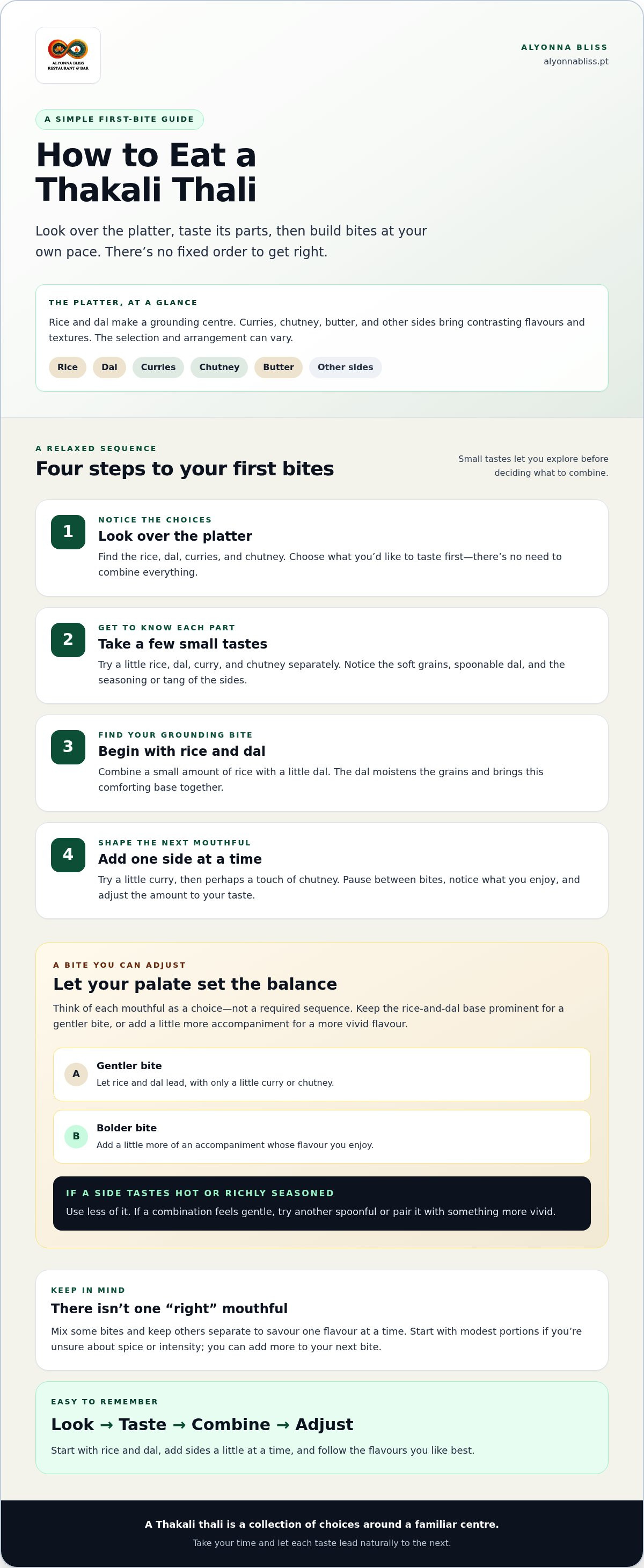
- Look over the platter. Notice where the rice, dal, curries, and chutney sit. Decide what you’d like to taste first without feeling you have to combine everything.
- Take a few small tastes. Sample a little rice, dal, curry, and chutney separately. Notice the contrast between the soft grains, spoonable dal, and the seasoning or tang of the accompaniments.
- Begin with rice and dal. Combine a small amount of rice with a little dal. The dal moistens the grains and brings the bite together, giving you a comforting base for the other flavours.
- Add one side at a time. Try a little curry, then perhaps a touch of chutney. Adjust the amount to suit your taste and pause between bites to notice what you enjoy.
Start with small tastes before combining flavours
Tasting each component on its own gives you a clearer sense of its texture and seasoning. Rice may feel mild beside a more assertive curry, while chutney can bring a brighter contrast. Keep your first portions modest, especially if you’re unsure about spice or intensity. You can always add more to your next bite, making each combination a discovery rather than a commitment.
Make a balanced bite with rice, dal, and sides
Use a little rice as your base, then add enough dal to moisten the grains. Fold in a small amount of curry or chutney and taste how it changes the bite. For a gentler mouthful, use less of the stronger accompaniment. If you enjoy vivid flavours, add a little more. Pause between bites and let your preferences set the pace.
A simple way to remember how to eat thakali thali: look, taste, combine, and adjust. Start with rice and dal, add sides a little at a time, and follow the flavours you like best, not a strict sequence.
Some bites can be mixed, while others can stay separate so you can savour one flavour at a time. Both approaches work. Alyonna Bliss serves a Nepali Thakali platter with dal, rice, chutney, a variety of curries, butter, and more. Explore the Nepali Thakali platter as you build each bite at your own pace.
How to Balance Flavours on a Thakali Thali Without a Fixed Eating Order
Think of balance as a choice you make with each mouthful, not a sequence you have to follow. Rice and dal offer a mild, soft foundation; a curry or chutney can bring a more pronounced savoury, spicy, or tangy note. The strength of those flavours depends on the preparation and your palate, so there’s no single ideal combination to aim for.
Use the platter like a small flavour dial. Begin with a simple pairing, then adjust the next bite by adding a little more of an accompaniment or returning to the milder base. If a side tastes hot or richly seasoned, use less. If a combination feels gentle, try another spoonful or pair it with something more vivid. Learning how to eat thakali thali is about noticing what tastes good to you, not getting every bite “right.”
- For a gentler bite: Let rice and dal take the lead, with only a little curry or chutney.
- For a bolder bite: Add a small amount of a more assertive accompaniment, then taste before adding more.
- For contrast: Notice how a soft, saucy element feels beside a firmer or crisp component, if the platter includes one.
Texture can guide your choices as much as seasoning. A soft mouthful may feel comforting, while a firmer or crisp side, when present, can add contrast. Sourness and heat also vary between preparations. Don’t assume every chutney will be sharp or every curry fiery; taste first, then decide how much to add to the next bite.
Adjust each bite to your preferred intensity
If an accompaniment tastes strongly seasoned or spicy, begin with a smaller amount and build gradually. A little extra rice, when available, can soften an intense mouthful and help balance the flavours. Spice tolerance varies from person to person, and recipes differ, so your own comfort is the most useful measure. There’s no need to match someone else’s idea of the perfect level of heat.
Mix components or keep them separate?
Mixing components is practical, not compulsory. Sampling a side on its own can help you recognise its seasoning before combining it with rice or dal. Then alternate: one bite with a little curry, another kept simple, perhaps followed by chutney for a change of flavour. Moving between separate tastes and combined bites keeps the meal varied without requiring a fixed order.
Give yourself room to change your mind as you eat. The combination that suits your first bite may not be the one you want later. That’s part of the pleasure: a little softness, a brighter note, then a familiar, comforting pairing again.
Thakali Thali Dining Etiquette: Enjoy the Meal Comfortably
A Thakali thali is an invitation to enjoy a generous, varied meal, not a test of cultural knowledge. There’s no strict sequence to follow: take your time, choose the flavours that appeal, and eat in the way that feels comfortable. Consideration for the people around you matters more than copying a particular technique.
Choose hands or cutlery with confidence
Many people enjoy South Asian meals by hand, while cutlery is also a comfortable choice. If you prefer using your hands, wash them first and use whichever technique feels natural. There’s no need to get it exactly right. Choosing a spoon or fork doesn’t make your enjoyment less genuine. The meal is there to be savoured, not to judge how you eat.
Sharing depends on the setting. If components are served communally and everyone is happy to share, use the serving utensil where provided and take a portion onto your own plate. If each diner has an individual platter, enjoy your own serving instead of assuming dishes are shared. A quick look at how the meal is arranged helps keep the table comfortable for everyone.
Navigate preferences, spice, and dietary needs
Recipes and ingredients can vary, so don’t assume every curry has the same heat or that a dish suits a particular diet based on its name alone. Vegetarian suitability depends on the specific curries and how they’re prepared. If you avoid an ingredient or have an allergy, ask about the ingredients before eating rather than relying on appearance alone. That’s a practical dietary question, not a breach of etiquette.
If a mouthful feels more intensely seasoned or spicy than expected, pause and take a sip of water. You can also return to a milder part of the meal or take a smaller bite next time. There’s no need to finish a component that doesn’t suit you or keep pace with another diner. Comfort matters more than proving you can handle heat.
Let the table guide shared dining, too. Some people enjoy offering tastes across the table; others prefer to keep their food separate. Follow the serving arrangement and the preferences of those eating with you, and don’t share food or utensils that have touched someone’s mouth. A warm meal can be communal without requiring everyone to eat from the same plate.
In short, how to eat thakali thali comfortably comes down to choosing your utensil, pace, and portions with care for yourself and the people sharing the table. For a meal that brings dal, rice, chutney, curries, butter, and more together, enjoy a Nepali Thakali platter at Alyonna Bliss.
Enjoy a Thakali Thali at Alyonna Bliss: From First Taste to Last Bite
You don’t need to know every dish or follow a set order to enjoy a Thakali thali. The simple rhythm is to taste, combine, adjust, and take your time. Begin with a small bite, notice how the flavours and textures meet, then decide what you’d like to add next. A pause between tastes gives you room to find satisfying combinations instead of rushing through the platter in a prescribed way.
What to expect from the Alyonna Bliss Thakali platter
The Nepali Thakali platter at Alyonna Bliss brings together rice, dal, chutney, a variety of curries, butter, and more. Each element has a place among the others, creating a meal you can explore in different combinations. Think of it as a collection of complementary tastes, not a test with a correct order or a perfect way to build each mouthful. Start with the familiar components, then find your own rhythm.
You might keep one taste simple, then add a little of another component to see how the balance changes. There’s no need to combine every part or decide on a favourite straight away. Let the platter unfold gradually.
Turn your first visit into an enjoyable tasting experience
Give yourself permission to begin gently. Taste individual components, then try a combination that sounds appealing. If a flavour feels especially pronounced, use less of it in the next bite; if you enjoy the balance, return to it. Alternate between separate tastes and mixed mouthfuls, slowing down whenever you want to savour a flavour. This flexible approach makes an unfamiliar platter easier to enjoy without turning the meal into a list of instructions.
That ease is part of the pleasure of a generous meal: a welcoming spread, a little curiosity, and the freedom to eat at your own pace. Notice what brings comfort, what adds contrast, and which pairings you’d happily revisit. Your preferred combination may change as you go, and that’s perfectly natural. There’s no final rule to master, only the satisfaction of enjoying each bite in a way that suits you.
Now that you know how to eat thakali thali, bring that relaxed curiosity to the table. Explore the Nepali and Indian menu at Alyonna Bliss and discover the flavours that make the meal your own.
Let Your Next Thali Be a Moment of Discovery
Your first Thakali thali doesn’t need to be perfect. Let curiosity lead: try a flavour you haven’t tasted before, return to a combination you enjoyed, and leave room for the meal to surprise you. That freedom is at the heart of learning how to eat thakali thali. Each platter offers a chance to discover something at your own pace, with no rigid order to memorise and no single “right” bite to chase.
Make the experience your own, whether you’re sharing the meal around a table or enjoying it in a quieter moment. At Alyonna Bliss, you can savour a Nepali thali in the restaurant, or choose takeaway or delivery. Explore the Nepali and Indian menu and choose a meal that calls to you.
Come with an open appetite and an easy pace. The best next bite is simply the one you’re looking forward to.
Frequently Asked Questions
Is Thakali thali spicy?
It can be, but the level of heat depends on the particular curries and chutney, as well as how they’re prepared. If you’re sensitive to spice, try a small taste of each accompaniment before adding it to a larger bite. A little rice or dal can help mellow a strong flavour. Seasoning varies between platters, so let your own comfort guide you.
Can I eat Thakali thali with my hands?
Yes, you can enjoy it with your hands, and cutlery is also perfectly suitable. If you choose to eat by hand, wash your hands before the meal and use the fingers that feel comfortable. You don’t need to imitate a particular technique to show appreciation. For example, you might use your fingers for rice and dal, then reach for a spoon if that feels easier for a saucier component.
Is Thakali thali vegetarian or vegan?
It depends on the particular set and how its components are prepared. A platter may include vegetarian curries, but that doesn’t automatically mean every item is meat-free. Alyonna Bliss’s Thakali platter includes butter, so it isn’t vegan as described. If you follow a vegetarian or vegan diet, identify which components suit your needs and avoid those that don’t.
Is Thakali thali the same as dal bhat?
They’re related, but the terms don’t mean exactly the same thing. Dal bhat describes the familiar pairing of lentils and rice, while a Thakali thali presents that foundation as part of a more composed meal with accompanying dishes. A useful comparison is a simple rice-and-dal meal beside a platter that offers several sides to explore. The exact selection can differ by restaurant.
Can I share a Thakali thali?
You can share if the serving arrangement and everyone at the table suit it. If the food is presented on individual plates, treat each platter as one person’s meal. If there are shared dishes, use a serving utensil when provided and place food onto your own plate. As a considerate practice, don’t share food or utensils that have touched your mouth.
What does Thakali mean in Thakali thali?
“Thakali” refers to the Thakali people and their culinary tradition. It identifies the cultural tradition behind this style of meal, rather than simply describing a collection of dishes on a plate. The name offers useful context: a Thakali thali is a composed meal connected to a community and its foodways, not just another term for any rice platter.


